Accessibility StatementLearn more
News

Accessibility Statement›News

EAA microenterprise exemption: fewer than 10 people and under €2 million, and the…

· 2 min read

In briefThe European Accessibility Act, which has applied since 28 June 2025, exempts microenterprises that provide services — defined as fewer than 10 employees and annual turnover under €2 million. Both thresholds must be met simultaneously, and the exemption covers services only: microenterprises that sell products into the EU must still comply with the product requirements.
Learn more →

The European Accessibility Act (Directive 2019/882) has applied since 28 June 2025. Its scope is wide, but it contains an explicit exemption that many compliance discussions omit.

Who is a microenterprise under the EAA?

The EAA adopts the EU definition: an enterprise with fewer than 10 employees and an annual turnover or balance sheet total that does not exceed €2 million. Both conditions must be satisfied at the same time. Failing either one removes the exemption entirely. A company with 9 employees and €2.3 million in turnover does not qualify — the revenue threshold is breached.

The exemption applies to services, not to products

This is the distinction that changes the analysis. A microenterprise providing a covered service — e-commerce, banking, e-books, electronic communications, passenger transport booking, audiovisual access — is exempt from the EAA requirements that apply to that service. A microenterprise that manufactures or sells a covered product into the EU is not exempt from the product requirements. It is only exempt from the administrative obligation to carry out and document a disproportionate-burden assessment.

Three scenarios illustrate the difference:

How to count employees and turnover

The employee count covers the headcount of the enterprise, not full-time equivalents alone. Turnover is the annual figure. For linked or partner enterprises under EU recommendation 2003/361/EC, the figures of related entities may need to be aggregated — a company that is part of a larger group cannot rely on its own figures alone.

Where the exemption stops at the border

The exemption is European. It has no equivalent in Ontario or the United Kingdom. A nine-person service company selling into Toronto is not exempt under the Accessibility for Ontarians with Disabilities Act (AODA): Ontario has no size exemption. The same company selling into the UK has no size threshold to rely on under the Equality Act 2010. The EAA microenterprise exemption applies only to obligations arising from Directive 2019/882 itself.

If a business is a microenterprise providing services exclusively within the EU and passes both tests, the EAA imposes no accessibility statement or conformance obligation. That is the law as written. If the same business also operates in Ontario or the UK, separate obligations apply in those jurisdictions regardless of size.

Key points

  • The EAA microenterprise exemption requires both conditions together: fewer than 10 employees and annual turnover under €2 million.
  • The exemption covers service providers only; microenterprises selling products into the EU must still meet the product accessibility requirements.
  • The EAA has applied since 28 June 2025; companies that passed both thresholds on that date were exempt from day one.
  • The exemption is specific to Directive 2019/882 and does not transfer to Ontario (AODA) or the UK (Equality Act 2010), which have no equivalent size thresholds.
  • Companies that are part of a larger group may need to aggregate employee and turnover figures with linked or partner enterprises before applying the threshold test.

Frequently asked questions

Does the EAA microenterprise exemption apply automatically?

Yes, if both thresholds are met — fewer than 10 employees and annual turnover or balance sheet total under €2 million — the exemption applies by operation of Directive 2019/882. No application or registration is required, but the company should document that it meets both criteria in case of an inspection.

My company has 8 employees but €2.5 million in turnover. Are we exempt?

No. The EAA requires both tests to be passed simultaneously. Exceeding the €2 million turnover threshold removes the exemption entirely, regardless of headcount.

We sell software-as-a-service to EU consumers and have 7 employees and €1.8 million in revenue. Do we need an EAA accessibility statement?

If your company qualifies as a microenterprise under EU Recommendation 2003/361/EC — fewer than 10 employees and turnover under €2 million — the EAA service requirements do not apply to you. You are not required to produce an Annex V accessibility statement under the EAA.

Does the EAA microenterprise exemption apply to companies outside the EU?

The exemption is defined in terms of enterprise size, not location. A non-EU company offering a covered service to EU consumers may rely on the exemption if it meets both thresholds. However, the determination of which entities count as linked or partner enterprises follows EU Recommendation 2003/361/EC, which a non-EU parent structure may complicate.

We are exempt from the EAA. Do we still need to comply with AODA or UK rules?

Yes. The EAA microenterprise exemption has no effect on obligations under the Accessibility for Ontarians with Disabilities Act (AODA) or the UK Equality Act 2010. Ontario has no size exemption; the UK has no size threshold. A company exempt in Europe may still have obligations in both other jurisdictions.
Learn more →

Keep reading

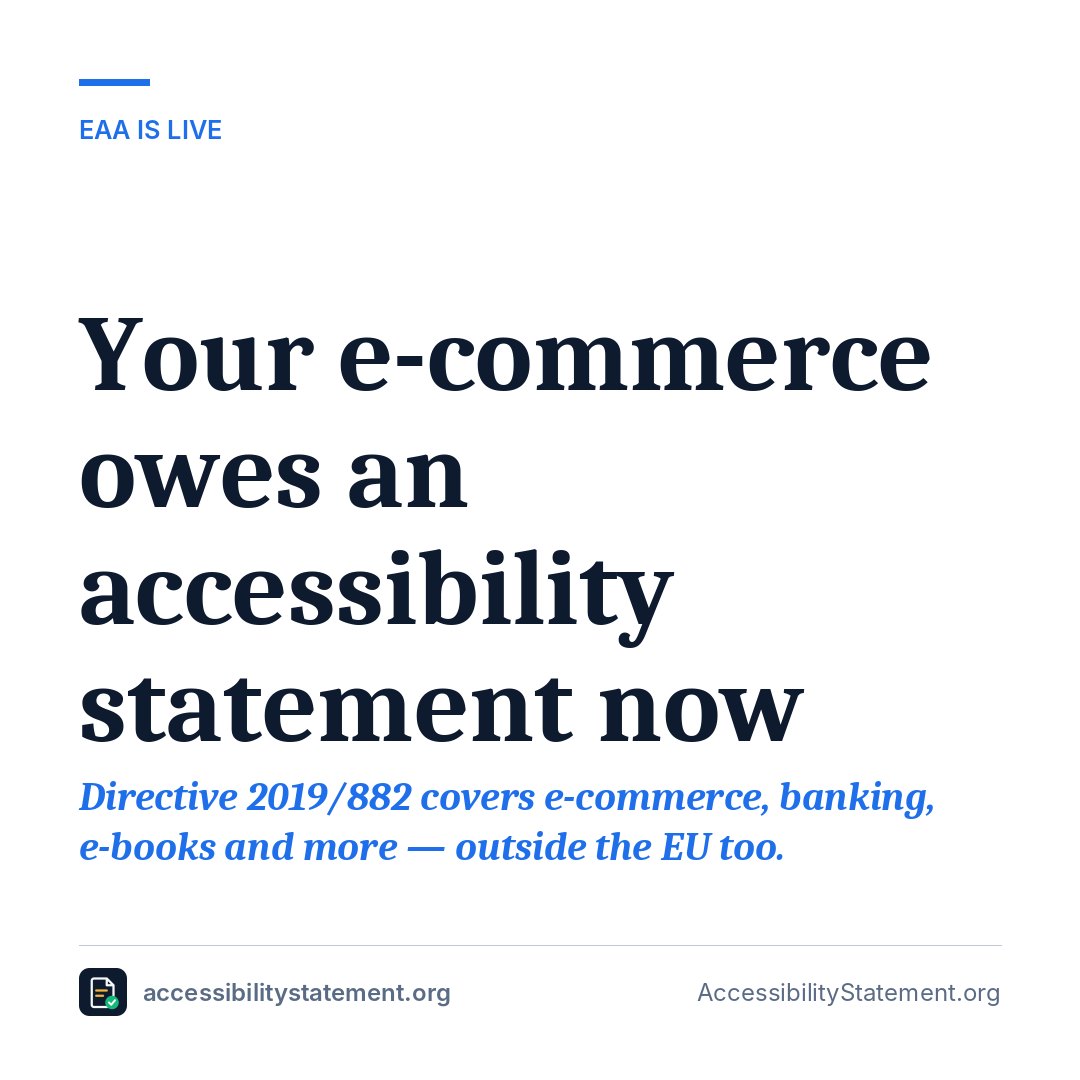
6 November. Fifty-five days to 31 December 2026. There is one line on the Ontario…Video · 21s06.11.2026 · EN6 November. Fifty-five days to 31 December 2026. There is one line on the Ontario…Ontario organizations with 20 or more employees must file an AODA compliance report by 31 December 2026. The report includes a question about whether the website meets WCAG 2.0 Level AA. Answering 'no' with a remediation schedule is a defensible position; not filing at all is not.▶ Watch the video4 November. Fifty-seven days to 31 December 2026 — and the website is the part people…Video · 22s04.11.2026 · EN4 November. Fifty-seven days to 31 December 2026 — and the website is the part people…The AODA compliance report due 31 December 2026 asks who was trained, on what, and when — not whether your website passes a technical audit. Organizations with 20 or more employees in Ontario must have training records showing dates and headcounts, covering all employees, volunteers, and contracted staff who serve the public.▶ Watch the videoYour website passes. Your AODA report still fails.04.11.2026 · ENYour website passes. Your AODA report still fails.Ontario organizations with 50 or more employees must file an AODA compliance report by 31 December 2026. A WCAG test covers website performance against one technical standard; it does not replace the written accessibility policy, the multi-year accessibility plan, the individual accommodation plans, or the signed self-certification filed by a senior officer.Read the article →3 November. Fifty-eight days to 31 December 2026 — and the question almost nobody asks…Video · 21s03.11.2026 · EN3 November. Fifty-eight days to 31 December 2026 — and the question almost nobody asks…The AODA compliance report deadline is 31 December 2026 for Ontario organizations with 20 or more employees. The first-year fee is 890 CAD; every subsequent year costs 712 CAD. Organizations that filed in 2023 with another provider, or hold a WCAG audit under twelve months old, start at the renewal price of 712 CAD.▶ Watch the video1 November. Sixty days to 31 December 2026 — and roughly forty of them are usable. That…Video · 21s02.11.2026 · EN1 November. Sixty days to 31 December 2026 — and roughly forty of them are usable. That…Private businesses and non-profit organizations with 20 or more employees in Ontario must file an AODA compliance report by 31 December 2026. December loses roughly half its working days to leave, so effective preparation time from 1 November is closer to 40 days than 60. Filing late — with barriers documented and a remediation schedule attached — is a defensible position; a missing filing is not.▶ Watch the video1 November. Sixty days to 31 December 2026 in Ontario — and in Europe the deadline passed…Video · 15s01.11.2026 · EN1 November. Sixty days to 31 December 2026 in Ontario — and in Europe the deadline passed…The AODA compliance report is due 31 December 2026 for Ontario organizations with 20 or more employees. The European Accessibility Act (Directive 2019/882) has applied since 28 June 2025 — there is no countdown left. The UK surfaces when a tender requires a WCAG 2.2 AA conformance report. One manual test against the same success criteria produces the evidence for all three; what changes is who signs.▶ Watch the video31 October. Sixty-one days to 31 December 2026. Somewhere in an Ontario company right now…Video · 22s31.10.2026 · EN31 October. Sixty-one days to 31 December 2026. Somewhere in an Ontario company right now…Private businesses and non-profit organizations with 20 or more employees in Ontario must file an AODA compliance report by 31 December 2026. An accessibility audit that lists barriers without a WCAG criterion number, an exact page reference, and a reproduction path is a document a developer cannot act on — and one you effectively pay for twice.▶ Watch the videoAccessibility statement for Ontario businesses: what holds up and what doesn't.Video · 46s30.10.2026 · ENAccessibility statement for Ontario businesses: what holds up and what doesn't.Private businesses and non-profit organizations with 20 or more employees in Ontario must file an AODA compliance report by 31 December 2026. Ontario does not issue AODA certification; no private company can issue one either. An accessibility statement holds up only when it is backed by a manual test and signed by a senior officer of the organization.▶ Watch the video29 October. Sixty-three days to 31 December 2026, and in most Ontario companies the file…Video · 22s29.10.2026 · EN29 October. Sixty-three days to 31 December 2026, and in most Ontario companies the file…Private businesses and non-profit organizations with 20 or more employees in Ontario must file an AODA compliance report by 31 December 2026. The report is a self-certification signed by a senior officer—a director, CFO, or owner—who attests to specific documented facts, not to a perfect website. On conviction, a corporation faces fines of up to 100,000 CAD per day and a director or officer up to 50,000 CAD per day.▶ Watch the video83 days. Then a name goes on a form in Ontario — and it is not the company's name, it is…Video · 22s26.10.2026 · EN83 days. Then a name goes on a form in Ontario — and it is not the company's name, it is…The AODA compliance report due 31 December 2026 is self-certified in the Accessibility Compliance Reporting portal by a senior officer of the organization — a named individual, not a department. On conviction, that officer faces personal fines of up to $50,000 per day; the corporation faces up to $100,000 per day.▶ Watch the video23 October. Sixty-nine days to 31 December 2026. Statistics Canada, 2022: one in four…Video · 50s23.10.2026 · EN23 October. Sixty-nine days to 31 December 2026. Statistics Canada, 2022: one in four…Organizations with 20 or more employees in Ontario must file an AODA compliance report by 31 December 2026. Statistics Canada (2022) reports that one in four people in Canada has a disability — barriers on a checkout page do not generate complaint tickets; users leave and the session looks like any other bounce.▶ Watch the videoYour e-commerce owes an accessibility statement now23.10.2026 · ENYour e-commerce owes an accessibility statement nowSince 28 June 2025, Directive 2019/882 (European Accessibility Act) requires an Annex V accessibility statement from any business offering covered services to consumers in the EU — including businesses registered outside the Union. Covered services include e-commerce, banking, e-books, electronic communications, passenger transport booking and audiovisual access. The obligation rests on the service provider, not the platform.Read the article →21 October. Seventy-one days to 31 December 2026 — except the last useful day is not 31…Video · 15s21.10.2026 · EN21 October. Seventy-one days to 31 December 2026 — except the last useful day is not 31…Private businesses and non-profit organizations with 20 or more employees in Ontario must file an AODA compliance report by 31 December 2026. The officer certification in the Accessibility Compliance Reporting portal cannot happen before the supporting documents exist — which puts the real last date to start in early December at the latest, not 31 December.▶ Watch the video20 October. Seventy-two days to 31 December 2026. The Ontario compliance report is a…Video · 16s20.10.2026 · EN20 October. Seventy-two days to 31 December 2026. The Ontario compliance report is a…Private businesses and non-profit organizations with 20 or more employees in Ontario must file an AODA compliance report by 31 December 2026. The report is a self-declaration: no one verifies it at filing, but an inspector can request the evidence behind every answer. The five areas checked first are: WCAG test documentation, policy publication, feedback process records, employee count method, and multi-year plan review dates.▶ Watch the videoA Delaware company told me last week they were "out of scope" because they have no…Video · 15s17.10.2026 · ENA Delaware company told me last week they were "out of scope" because they have no…The AODA compliance report deadline is 31 December 2026. The filing obligation follows employees working in Ontario, not the company's registered address. A Delaware, UK, or Australian company with 20 or more people working in Ontario files the same report as a Toronto company.▶ Watch the videoI spent an afternoon reading the websites of nine accessibility suppliers selling into…Video · 44s15.10.2026 · ENI spent an afternoon reading the websites of nine accessibility suppliers selling into…Ontario does not certify websites or organizations under the AODA. There is no provincial register, no accrediting body, and no seal the government issues. The regulation requires a self-certification compliance report, signed by a senior officer, due 31 December 2026 for organizations with 20 or more employees in Ontario.▶ Watch the video
All newsRSS